Six Sigma is one of the most widely recognized process improvement frameworks in the world. Originally developed at Motorola in the 1980s and later popularized by General Electric, it has since spread far beyond manufacturing into healthcare, finance, logistics, software, and any other industry where processes can be measured and improved.
One of its most distinctive features is its belt ranking system — borrowed conceptually from martial arts — where each level represents a deeper degree of expertise and a broader scope of responsibility. This article breaks down what each belt actually means in practice.
The Logic Behind the Belt System
The Six Sigma belt framework is designed as a progressive learning path. Each level builds on the one before it, ensuring practitioners develop foundational knowledge before taking on more complex responsibilities. For organizations, it creates a clear hierarchy of expertise: the right people leading the right initiatives at the right scale.
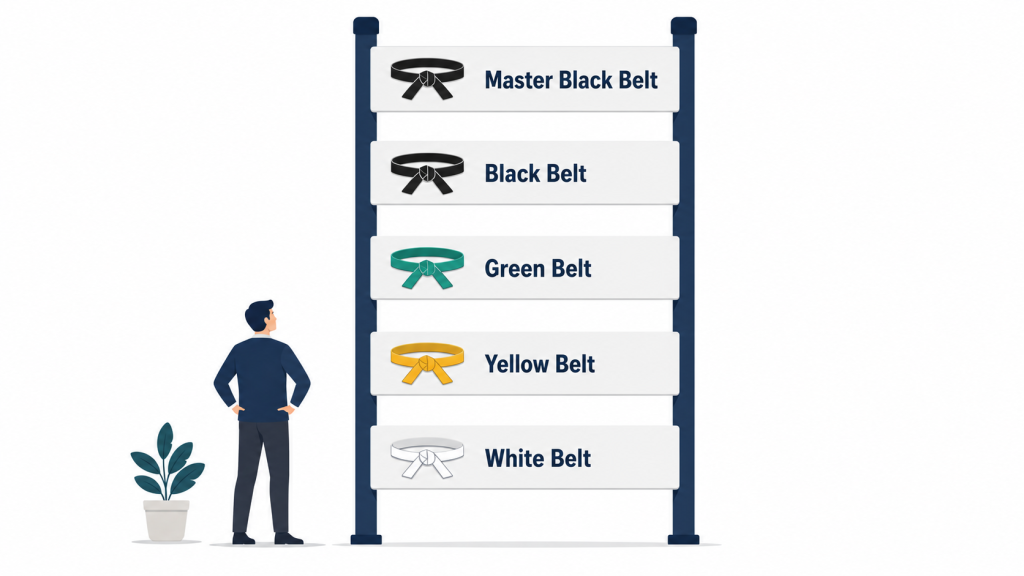
There are five recognized belt levels: White Belt, Yellow Belt, Green Belt, Black Belt, and Master Black Belt.
White Belt: The Starting Point
The White Belt is the entry-level introduction to Six Sigma and requires no prior knowledge. Its goal is to give employees a working awareness of what Six Sigma is and how it fits into organizational improvement efforts.
At this level, practitioners learn:
- Core Six Sigma vocabulary
- The general philosophy of process improvement and waste reduction
- How Six Sigma projects are typically structured
White Belts do not lead projects. They support local team initiatives, participate in problem-solving discussions, and help identify waste or inefficiencies in their day-to-day work. Think of them as informed participants — they understand the language and goals of Six Sigma well enough to contribute meaningfully when called upon.
The White Belt is suitable for anyone new to process improvement. It is a low-barrier starting point that raises general quality awareness across an entire workforce. Note that many organizations fold White Belt concepts into Yellow Belt training rather than treating it as a separate certification level.
Yellow Belt: The Informed Contributor
A Yellow Belt holder has a solid foundational understanding of Six Sigma principles and can take on more active roles within project teams. They are still not project leaders, but they are far more than passive observers.
Yellow Belts learn the fundamentals of data collection and analysis, and they develop the skills needed to actively support process improvement initiatives. On a project team, they often serve as subject matter experts — bringing specific domain knowledge relevant to the process being improved — and assist Green Belt and Black Belt project leaders with data gathering and analysis tasks.
Yellow Belt certification typically takes one to three days and concludes with a written exam. This belt is well suited for team members and individual contributors who want to actively participate in improvement projects, rather than simply being aware that they exist.
Green Belt: The Project Leader for Smaller Initiatives
The Green Belt is where practitioners begin to take on leadership responsibilities. At this level, professionals are equipped to lead well-defined improvement initiatives within their own functional areas while contributing to larger, cross-functional projects led by Black Belts.
Green Belts typically:
- Manage improvement projects from start to finish
- Facilitate small project teams
- Collect and analyze data
- Serve as a bridge between project leadership and frontline employees
Green Belt training also introduces a core Six Sigma methodology: DMAIC — Define, Measure, Analyze, Improve, and Control. DMAIC guides teams from clearly defining a problem through measuring and analyzing performance, implementing improvements, and establishing controls to sustain results over time. Although the phases are presented sequentially, DMAIC is often iterative, and teams may revisit earlier phases as new data or insights emerge.
Black Belt: The Full-Time Improvement Expert
Black Belts are the engine of any serious Six Sigma program. At this level, process improvement is typically a full-time role — not a part-time responsibility alongside other work. Black Belts lead large and complex projects, manage teams of Green Belts, and serve as mentors and trainers for lower belt holders.
Unlike Green Belts, who often focus on departmental improvements, Black Belts lead cross-functional initiatives that affect multiple processes, teams, or business units.
The depth of knowledge required is significant. Black Belts are trained in advanced statistical and analytical methods including hypothesis testing, regression analysis, statistical process control (SPC), and Design of Experiments (DOE). They also develop strong capabilities in project leadership, change management, and the application of Lean principles alongside Six Sigma.
In practice, Black Belts:
- Lead high-impact, organization-wide improvement projects
- Train and mentor practitioners at all lower belt levels
- Apply Lean principles to eliminate waste while reducing variability
- Communicate project results and business impact directly to senior stakeholders
Black Belt training typically spans two to four weeks of intensive coursework. Most certification providers require candidates to pass a comprehensive exam and complete one or more real-world improvement projects, ensuring skills are applied in practice, not just studied in a classroom.
Master Black Belt: The Strategic Leader
Master Black Belt is the highest level of Six Sigma certification. Professionals at this level have moved beyond project execution into strategic leadership and organizational development.
Master Black Belts:
- Identify which projects align with organizational strategy and set priorities accordingly
- Mentor and coach Black Belts and Green Belts across the organization
- Teach Six Sigma methodology at all levels
- Communicate directly with executives and senior leadership to secure support for improvement initiatives
- Shape the organization’s overall process improvement strategy
Unlike Black Belts, who are often deeply embedded in specific projects, Master Black Belts operate at a higher level. They provide expert guidance, resolve escalated challenges, and ensure that Six Sigma creates lasting cultural change rather than just a series of one-off project wins.
Most organizations have only one or two Master Black Belts. Larger or more decentralized organizations may have one per major hub or division. This level is for experienced Black Belts who have led multiple complex projects, developed other practitioners, and are ready to shape the entire organization.
How the Belt Levels Work Together
Here is a practical way to think about how the belts function within a real improvement initiative:
| Belt | Primary Role |
|---|---|
| Master Black Belt | Strategic oversight, mentoring, executive communication |
| Black Belt | Project leadership, statistical analysis, team management |
| Green Belt | Sub-project leadership, data collection, team support |
| Yellow Belt | Subject matter expertise, task-level support |
| White Belt | Awareness-level participation, local problem-solving |
Which Belt Is Right for You?
If you are new to Six Sigma, starting with White or Yellow Belt is the right move. The concepts are accessible and the time investment is low.
If you are already working in quality, operations, or process engineering and want to drive real change, Green Belt is the natural next step.
Black Belt is for those ready to make process improvement a dedicated professional focus.
The belt system is designed so that each level prepares you for the next. There is no shortcut to Master Black Belt — and that is the point. The framework works because expertise is built deliberately, layer by layer.
Leave a Reply